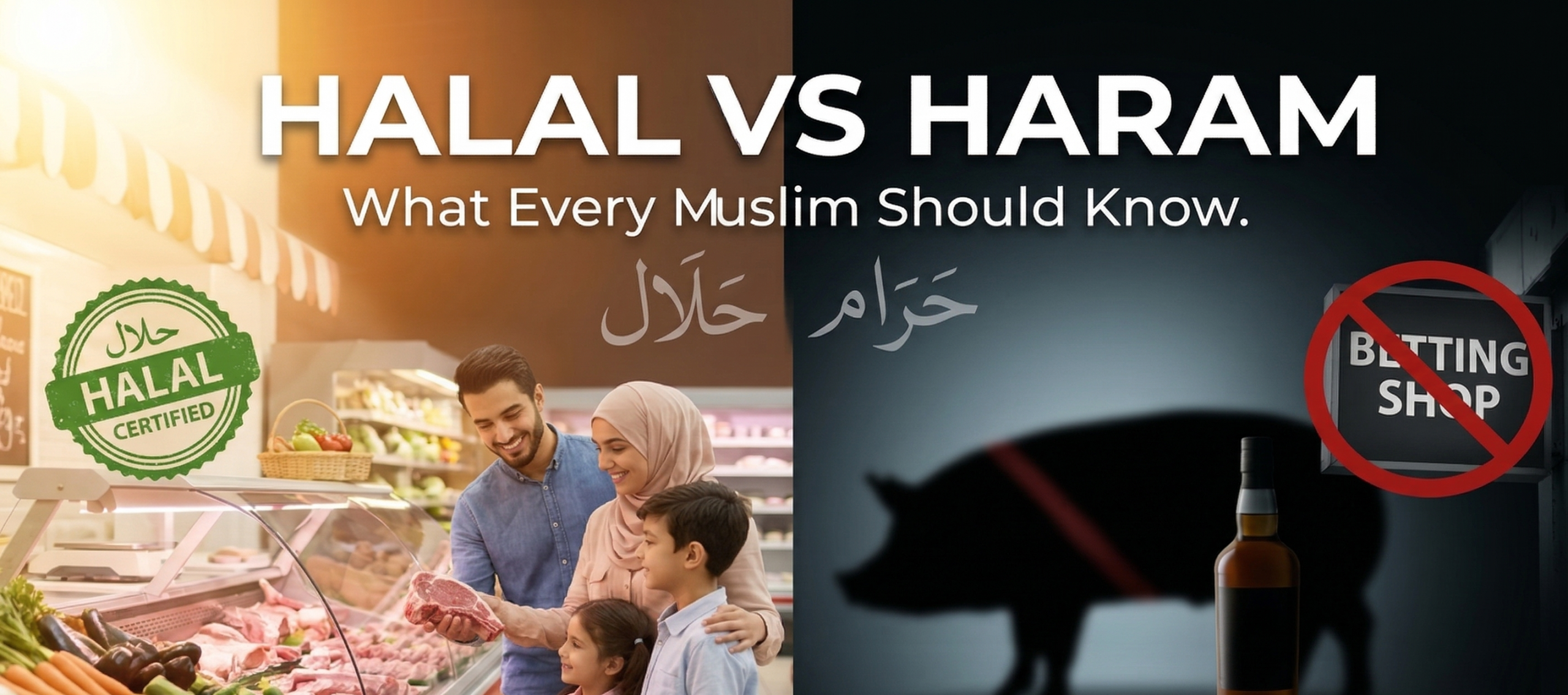
For Muslims around the world, Islam is not just a set of beliefs but a complete way of life. Every action, transaction, and meal is guided by a divine framework designed to promote physical health, spiritual purity, and social harmony. At the very center of this framework are two foundational concepts: Halal and Haram.
Whether you are a born Muslim seeking to refresh your knowledge, a new revert navigating your daily routine, or simply someone curious about Islamic practices, understanding the clear distinction between Halal and Haram is essential.
Here is a comprehensive guide to what these terms mean, how they apply to modern life, and why they go far beyond just the food on your plate.
Understanding the Basics: What is Halal?
Linguistically, the Arabic word Halal translates to “permissible” or “lawful.” In the context of Islamic jurisprudence, it refers to any object or action that is permitted under Islamic law (Shariah).
The general rule in Islamic law is that everything is considered Halal unless there is specific evidence in the Quran or the Hadith (the sayings and actions of Prophet Muhammad, peace be upon him) explicitly forbidding it. This highlights the inherent ease and flexibility of the Islamic lifestyle.
Furthermore, Islam emphasizes that Halal goes hand-in-hand with Tayyib, which means “pure,” “wholesome,” or “good.” For instance, a piece of meat might be technically Halal because of how it was slaughtered, but if the animal was severely abused or fed unnatural, toxic diets, it may fall short of the standard of Tayyib.
What is Haram? Navigating the Prohibitions
Haram is the exact opposite of Halal. It translates to “forbidden” or “prohibited.” Engaging in acts that are Haram is considered a sin, while actively avoiding them out of obedience to God is highly rewarded.
The prohibitions in Islam are not arbitrary; they are set in place to protect individuals and society from physical, mental, and spiritual harm.
Common Haram Foods and Beverages
When most people think of Haram, dietary restrictions are the first things that come to mind. The primary prohibitions include:
- Pork and its By-products: All derivatives of pigs, including bacon, ham, gelatin, and certain enzymes, are strictly forbidden.
- Intoxicants (Khamr): This includes all forms of alcohol, recreational drugs, and any substance that clouds the mind or impairs judgment.
- Blood: The consumption of flowing blood is prohibited.
- Improperly Slaughtered Animals: Meat from lawful animals (like cows, sheep, or chickens) becomes Haram if the animal dies before slaughter, is killed by strangulation or blunt force, or is slaughtered in the name of anyone other than Allah.
- Predatory Animals: Birds of prey with talons and carnivorous animals with fangs (such as lions, wolves, and dogs) are prohibited.
The Gray Area: Understanding Mashbooh (Doubtful)
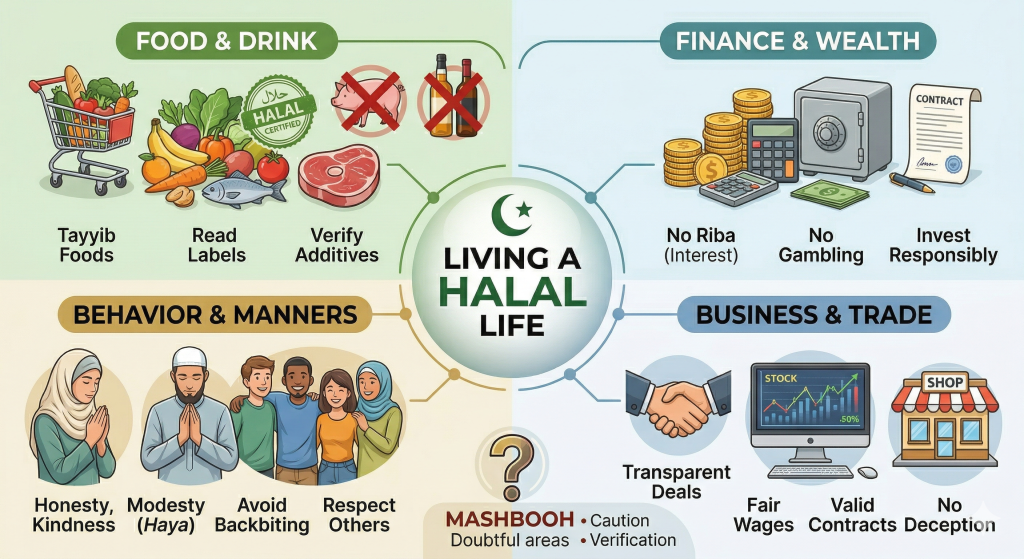
In today’s highly processed world, not everything falls neatly into a clear-cut category of Halal or Haram. This brings us to a crucial third category: Mashbooh, which translates to “doubtful” or “questionable.”
If a product contains complex food additives, artificial flavorings, or ambiguous ingredients like “natural flavors” or “emulsifiers” (which could be derived from plants or prohibited animals), it is classified as Mashbooh.
Islamic teachings advise Muslims to exercise caution. A famous Hadith states: “Leave that which makes you doubt for that which does not make you doubt.” When faced with a Mashbooh item, the best practice is to avoid it until you can verify its source.
Why Halal and Haram Matter Beyond Food
A common misconception is that these terms only apply to diet. In reality, the Halal and Haram framework governs every aspect of a Muslim’s existence.
1. Halal Earning and Islamic Finance
Earning a livelihood through Halal means is a profound act of worship. Wealth must be acquired honestly and ethically.
- Riba (Usury/Interest): Engaging in interest-based transactions is one of the most severe prohibitions in Islam.
- Maysir (Gambling): Lotteries, betting, and casinos are strictly Haram because they rely on chance and often lead to financial ruin and social breakdown.
- Gharar (Deception/Uncertainty): Contracts or business dealings that involve extreme uncertainty, fraud, or exploitation are invalid and forbidden.
2. Behavior and Social Conduct
How we treat others is heavily heavily regulated by this framework. Halal behavior involves honesty, keeping promises, modesty, and respecting parents. Conversely, actions like lying, backbiting (gossip), cheating, theft, and arrogance are distinctly Haram.
Practical Tips for Living a Halal Lifestyle Today
Navigating modern life—especially in non-Muslim majority countries—requires vigilance and education. Here are a few ways to easily maintain a Halal lifestyle:
- Read the Labels: Get into the habit of reading ingredient lists. Look out for hidden Haram ingredients like animal-derived rennet, gelatin (unless specified as fish, bovine Halal, or plant-based), and certain E-numbers.
- Use Technology: There are dozens of reliable mobile apps available that allow you to scan product barcodes to instantly verify if an item is Halal, Haram, or Mashbooh.
- Look for Certification: Support brands and restaurants that display official Halal certification from recognized Islamic bodies.
- Ask Questions: Whether you are at a restaurant or talking to a financial advisor, don’t be afraid to ask specific questions about how food is prepared or how your money is being invested.
1. For Halal Food & Dietary Laws
Linking to recognized Halal certification boards shows that your dietary information is accurate and standardized.
- Source: Islamic Food and Nutrition Council of America (IFANCA)
- Source: Halal Monitoring Committee (HMC)
2. For Islamic Finance & Halal Earning
When discussing Riba (interest) and Halal income, linking to global Islamic finance authorities adds massive credibility to your non-dietary sections.
- Source: Accounting and Auditing Organization for Islamic Financial Institutions (AAOIFI)
- Source: IslamicFinance.com or a reputable financial explainer on Riba.
3. For Quranic and Hadith References
Since you mentioned the general rule of Halal and a Hadith regarding “doubtful” (Mashbooh) things, linking to a digital database for these scriptures is highly recommended.
- Source: Sunnah.com (The Hadith of Nu’man bin Bashir regarding Halal, Haram, and doubtful matters).
- Source: Quran.com
Conclusion
Understanding Halal vs Haram is about much more than following a set of restrictive rules. It is about actively choosing a life of mindfulness, discipline, and purity. By striving to consume what is good, earn what is pure, and act with integrity, Muslims protect their physical well-being and nurture a closer, more conscious relationship with their Creator.
You can read Top 10 Authentic Hadith Every Muslim Must Know to Transform Their Life
Leave a Reply