
History is filled with tales of great leaders, conquerors, and visionaries. Yet, few stories possess the raw, transformative power of the life of Umar ibn al-Khattab (May Allah be pleased with him). He was a man of towering physical stature and an equally formidable presence. Known as Al-Farooq (The Distinguisher between truth and falsehood), Umar (RA) serves as one of the most profound examples of human potential.
If you are seeking motivation, struggling with your past, or looking for a timeless masterclass in leadership and justice, the story of the second Caliph of Islam will completely change your perspective on life.
The legacy of Umar (RA) laid the foundations for centuries of Islamic civilization.
Part 1: The Days of Ignorance (Jahiliyyah)
To truly appreciate the light of Umar’s faith, we must first understand the darkness from which he emerged. Before accepting Islam, Umar was a fierce and staunch defender of the polytheistic traditions of the Quraysh in Mecca. He was known for his sharp intellect, his prowess in wrestling, and his terrifying temper.
In the early days of Prophet Muhammad’s (Peace Be Upon Him) mission, Umar was one of the most severe oppressors of the new Muslim community. His hostility was so intense that the early believers feared him greatly. However, the Prophet (PBUH) saw the raw potential, leadership, and conviction within Umar. He made a specific, targeted prayer to Allah:
“O Allah, strengthen Islam with whichever of these two men is more beloved to You: Abu Jahl or Umar ibn al-Khattab.” > —Hadith narrated in Jami` at-Tirmidhi
Allah answered this prayer, choosing Umar to become a pillar of the faith he once sought to destroy.
Part 2: The Turning Point – A Heart Awakened by the Quran
The story of Umar’s conversion is one of the most dramatic and beautifully documented events in Islamic history.
Consumed by rage against the growing influence of Islam, Umar set out one day with his sword drawn, determined to assassinate the Prophet (PBUH). On his way, he was intercepted by a man who, hoping to divert him, revealed a shocking secret: Umar’s own sister, Fatimah, and her husband had secretly accepted Islam.
Enraged by this “betrayal” within his own family, Umar diverted his path to his sister’s house. As he approached, he heard the mesmerizing, melodic recitation of the Quran. He burst through the door, striking his sister in his blind fury. But when he saw the blood on her face, his heart—known for its hardness—suddenly softened with regret.
He asked to see the parchment they were reading. His sister insisted he wash himself first, as the words of Allah are pure. Umar complied. The verses written on the parchment were from the beginning of Surah Ta-Ha:
“We have not sent down to you the Qur’an that you be distressed. But only as a reminder for those who fear [Allah] – A revelation from He who created the earth and highest heavens.” —Quran, Surah Ta-Ha 20:2-4
Upon reading these words, the truth pierced his soul. The eloquence, majesty, and profound truth of the Quran shattered his previous beliefs. He immediately went to the Prophet (PBUH)—not to kill him, but to declare his faith.
The Lesson: No matter how far someone has strayed, or how deep their sins may seem, the heart can be transformed in an instant by the guidance of Allah. Never lose hope in your own ability to change, nor in the potential of others.
Part 3: Al-Farooq – The Era of Open Faith
Before Umar’s conversion, the Muslims were forced to practice their faith in secret, hiding in the House of Arqam out of fear of persecution. Umar’s entry into Islam changed the geopolitical landscape of Mecca overnight.
Umar famously asked the Prophet (PBUH), “Are we not upon the truth, whether we live or die?” When the Prophet affirmed this, Umar replied, “Then why should we hide our religion?”
For the first time, the Muslims marched publicly in two rows—one led by Hamza (RA) and the other by Umar (RA)—to the Kaaba to pray openly. It was on this day that the Prophet (PBUH) gave him the title Al-Farooq (The Distinguisher).
Umar’s courage paved the way for Muslims to practice their faith openly.
Part 4: The Golden Caliphate – A Masterclass in Justice
Following the death of the Prophet (PBUH) and the passing of the first Caliph, Abu Bakr (RA), the monumental weight of the Muslim Ummah fell upon Umar’s shoulders. His time as the second Caliph is remembered as a golden era of expansion, unparalleled justice, and administrative brilliance.
During his ten-year reign, the Islamic empire expanded vastly, defeating the mighty Persian and Byzantine empires. Yet, despite holding more power than the greatest kings of his era, Umar lived a life of astonishing asceticism and humility.
The Mother and the Boiling Stones
One of the most famous stories demonstrating his sense of accountability involves his nightly patrols through the streets of Medina.
One night, Umar and his companion Aslam heard the crying of children. They found a woman tending to a pot over a fire while her children wept from hunger. When Umar asked what she was cooking, she revealed that the pot contained only water and stones. She was boiling stones to trick her children into believing food was coming until they fell asleep from exhaustion.
She then said, “Allah will judge between us and Umar on the Day of Resurrection because he has neglected us.”
Devastated, Umar did not reveal his identity. Instead, he ran back to the state treasury, loaded a massive sack of flour, meat, and oil onto his own back. When his companion offered to carry it for him, Umar replied with tears in his eyes:
“Will you carry my burden for me on the Day of Judgment?”
Umar returned to the woman, personally cooked the food, and waited until he saw the children laughing and playing before he left.
The Conquest of Jerusalem
When the Muslims took control of Jerusalem, the Patriarch Sophronius insisted he would only hand the keys of the city to the Caliph himself.
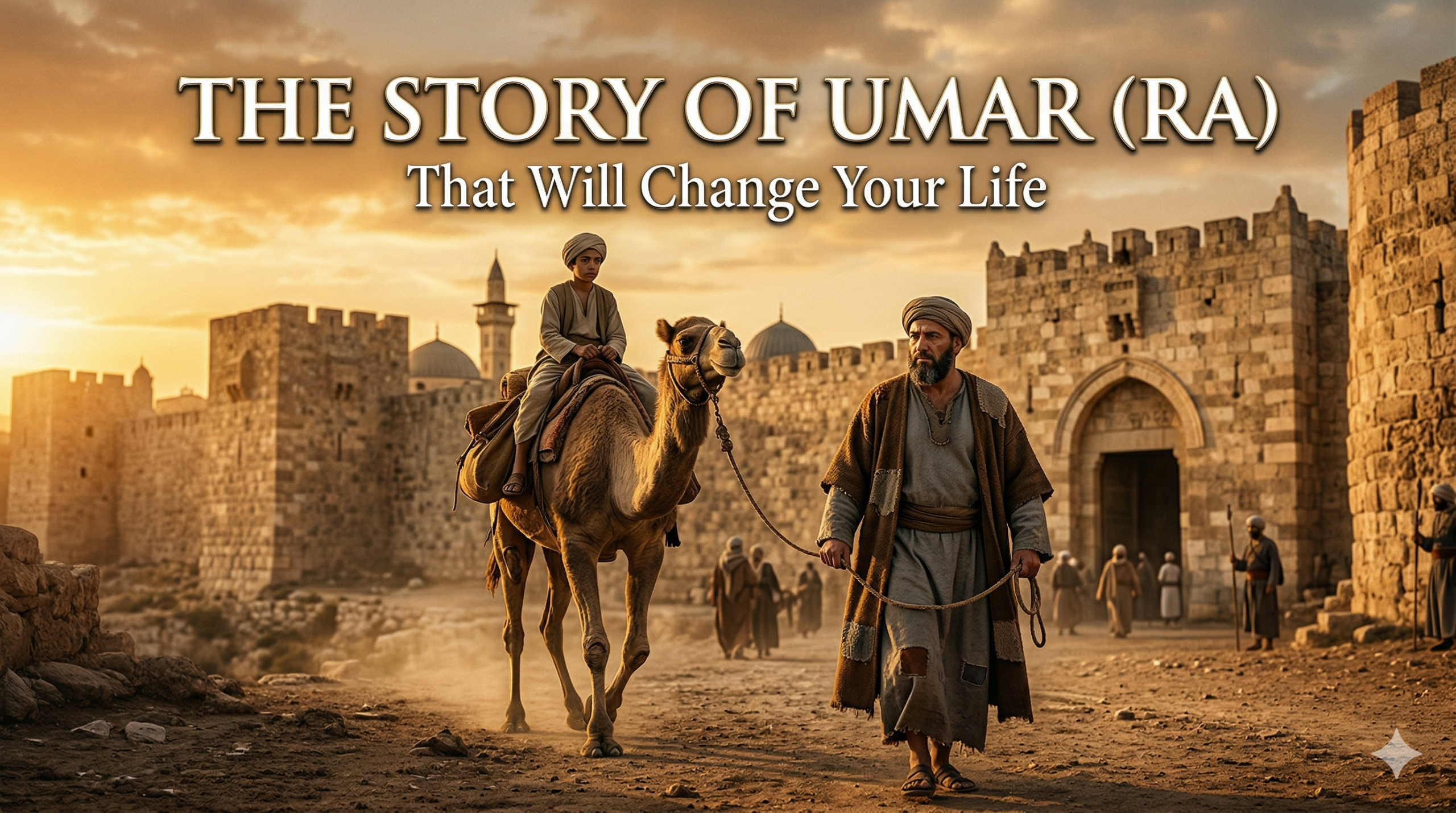
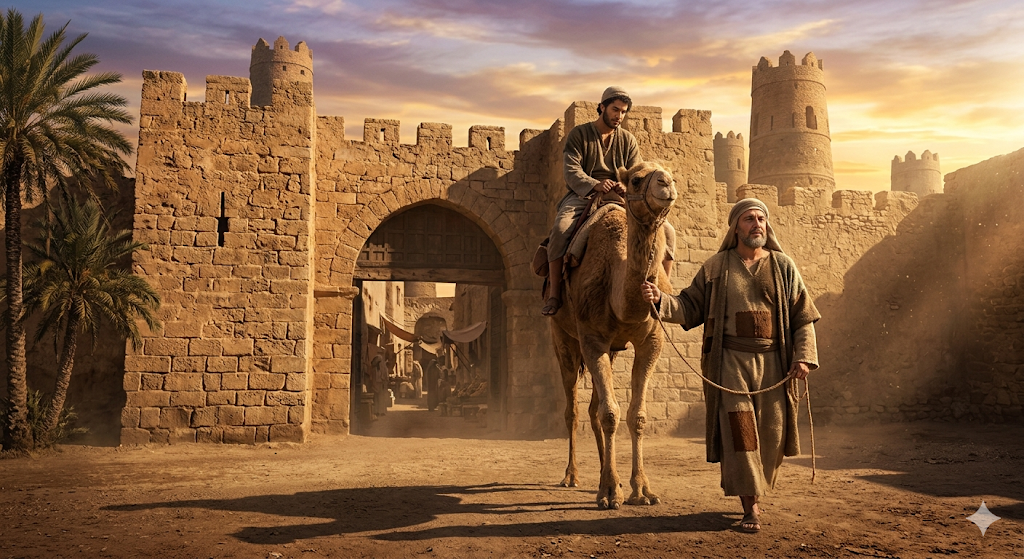
Umar traveled from Medina to Jerusalem. He brought only one servant and one camel, taking turns riding the animal. As they approached the city gates, it was the servant’s turn to ride. Thus, the most powerful ruler in the world entered the holy city walking, leading a camel by the rope, wearing a patched, dusty garment.
He established the Covenant of Umar, guaranteeing the safety, religious freedom, and protection of the Christian citizens and their churches—a revolutionary document of human rights and tolerance.
Part 5: Administrative Genius and State Welfare
Umar (RA) was not just a spiritual giant; he was a visionary statesman. His administrative innovations laid the groundwork for a modern welfare state:
- The Hijri Calendar: He established the Islamic lunar calendar, starting from the event of the Hijrah (migration to Medina).
- Public Welfare (Bait-ul-Mal): He instituted pensions for the elderly, widows, and orphans—regardless of whether they were Muslim or non-Muslim.
- Infrastructure: He ordered the construction of canals, roads, and cities (such as Basra and Kufa).
- Law Enforcement: He established a formal police force and a structured judicial system with appointed judges who were independent of the executive branch.
Part 6: Life-Changing Lessons from Umar (RA)
What can a modern individual learn from a man who lived fourteen centuries ago?
- Accountability is Everything: Umar constantly held himself accountable before Allah. He famously said, “Judge yourselves before you are judged, evaluate yourselves before you are evaluated.” * True Power is Rooted in Humility: Despite ruling an empire that stretched from Egypt to Persia, Umar slept on a bed of palm leaves and wore clothes with multiple patches. He proved that leadership is about service, not status.
- Justice is Blind: Umar did not play favorites. He enacted justice strictly, even against his own family members or appointed governors, ensuring that the law applied equally to the elite and the impoverished.
- Tawakkul (Reliance on God): He balanced immense effort with absolute reliance on Allah. He planned meticulously but knew ultimate success came only from the Divine.
Part 7: The Final Journey
Umar’s (RA) life came to a tragic but honorable end. While leading the Fajr (dawn) prayer in the Prophet’s Mosque, he was assassinated by Abu Lu’lu’ah, a Persian captive.
Even in his final moments, Umar’s primary concern was not his own life, but whether he had fulfilled his duty to his people and whether he had pleased Allah. His final request was to seek permission from Aisha (RA) to be buried next to his two closest companions: Prophet Muhammad (PBUH) and Abu Bakr (RA). She granted his request.
Conclusion
The story of Umar ibn al-Khattab (RA) is a testament to the fact that it is not where you start that defines you, but the path you choose to walk thereafter. He transformed his fiery temper into a burning passion for justice. He turned his pride into ultimate submission to the Almighty.
By studying his life, we are reminded that true strength lies in conquering one’s own ego, that true leadership is synonymous with servanthood, and that the mercy of Allah can elevate the harshest of hearts to the highest ranks of Paradise. May Allah be pleased with Umar, the Farooq of this Ummah, and may his legacy continue to inspire generations to come.
You can also read Best Tasbih for Forgiveness and Blessings: A Complete Guide for the Modern Muslim
Leave a Reply